
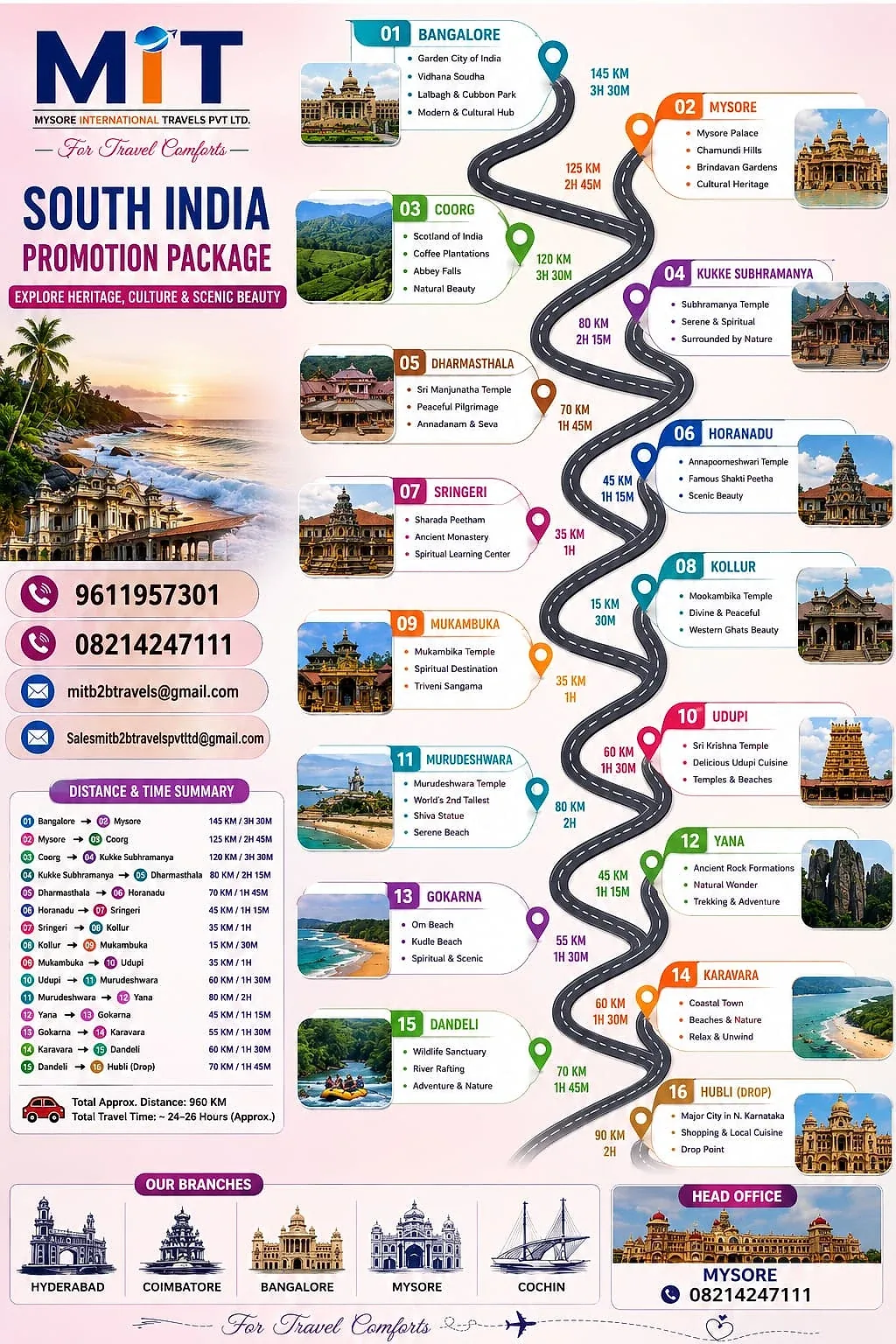
Bangalore → Mysore → Coorg → Dandeli → Hubli
South India Grand Circuit — Bangalore to Hubli
Explore Heritage, Culture & Scenic Beauty across Karnataka
Plan your Coorg getaway - coffee hills, Abbey Falls, Raja's Seat, Dubare. Get a customised Coorg tour package quote from MIT today.
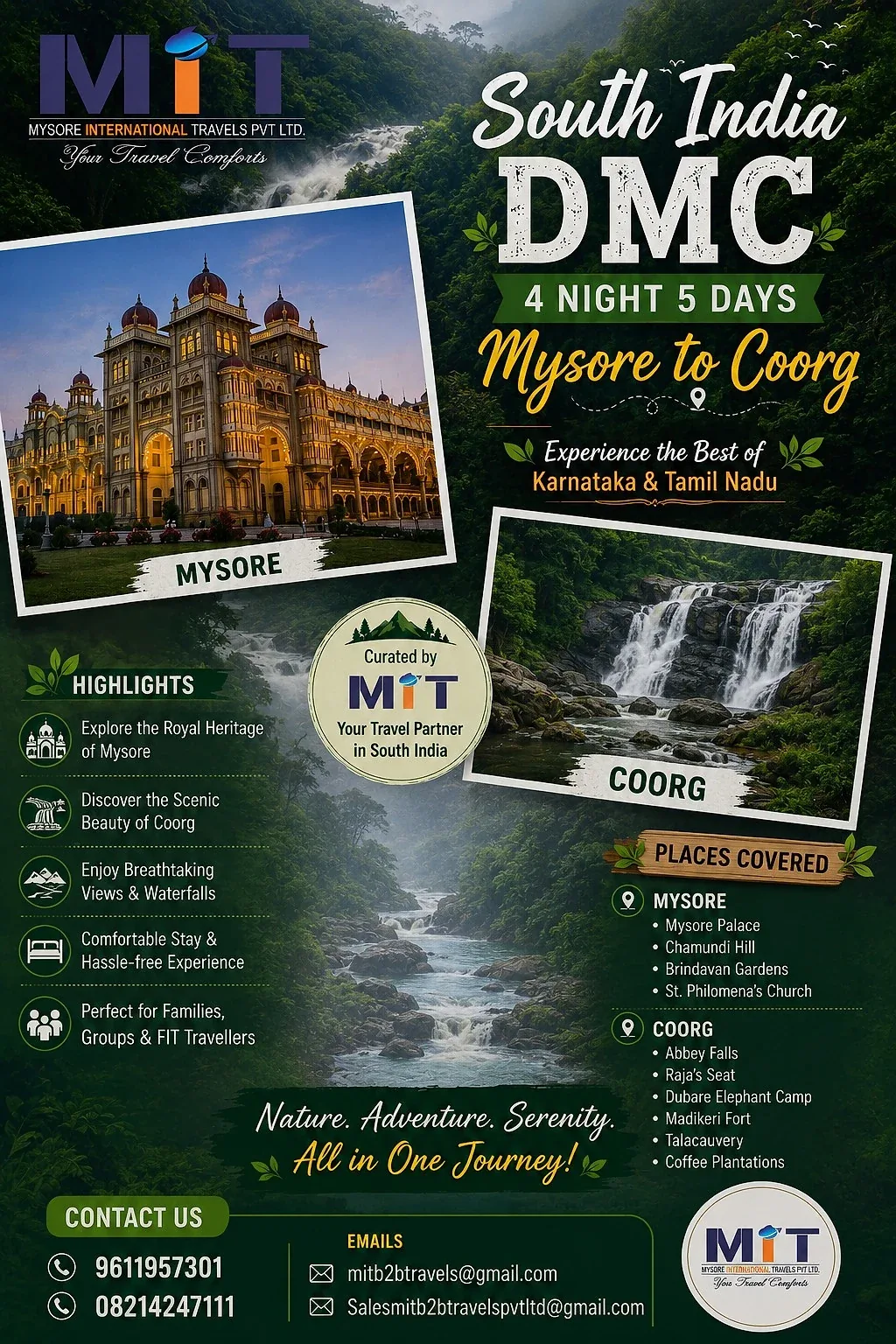
Coorg, officially Kodagu and centred around the hill town of Madikeri, is often called the "Scotland of India" for its rolling mist-covered hills, sprawling coffee estates, and cool, misty climate that feels a world apart from the plains of Karnataka. Tucked into the Western Ghats, it's home to the Kodava community's distinct culture and cuisine, thick forests that shelter elephants and tigers, and the source of the Kaveri river at Talakaveri, making it as much a nature and heritage destination as a scenic hill getaway.
Visitors come to Coorg for its waterfalls (Abbey Falls, Iruppu Falls), its viewpoints over the valley (Raja's Seat, Mandalpatti), the elephant camp on the Kaveri at Dubare, and the golden-roofed Namdroling Monastery nearby at Bylakuppe. Coffee, pepper, and cardamom plantations line the hillsides, and a plantation-stay or homestay experience is often the highlight of a Coorg trip, alongside jungle safaris in adjoining Nagarhole National Park.
As a South India DMC based in Mysore, MIT organises customised Coorg tour packages for couples, families, friend groups, and corporate teams travelling from Bangalore, Mysore, or anywhere else in India, and can combine Coorg with Kabini, Wayanad, or Mysore for a longer South India circuit. Whether you want a quiet plantation-stay weekend or an active itinerary with trekking and rafting, we tailor the plan, transport, and accommodation to what you're looking for.
October to March is the best window to visit Coorg (Madikeri), when the monsoon has washed the hills green and the weather turns cool and clear, ideal for sightseeing, plantation walks, and viewpoint sunsets. December and January are the coldest and most popular months (peak season, so book ahead), April to May is warmer but still pleasant in the mornings and evenings and works well if you want to see coffee blossoms, while June to September is the monsoon, when Coorg looks its most dramatic and waterfalls are at their fullest but trekking and viewpoint visits need extra caution due to slippery trails, leeches, and occasional landslides on ghat roads.
Coorg has a pleasant hill-district climate through most of the year thanks to its elevation in the Western Ghats. Winters (November-February) are cool and crisp, with daytime temperatures around 15-25°C and nights that can dip into single digits in higher areas, so warm layers are needed. Summers (March-May) are mild by plains standards, generally staying in the high 20s to mid-30s°C, though afternoons can feel warm in the valleys. The monsoon (June-September) is heavy, since Coorg sits directly in the path of the south-west monsoon and receives some of the highest rainfall in Karnataka, turning the district misty, lush, and waterfall-rich.
A comfortable Coorg trip runs 2 nights/3 days to 3 nights/4 days, which is enough to cover Madikeri town, Abbey Falls, Raja's Seat, and Dubare Elephant Camp at an easy pace with time for a plantation stay. If you want to add Talakaveri, Iruppu Falls, Mandalpatti, or a Nagarhole safari, or wish to combine Coorg with nearby Mysore or Kabini, stretching the trip to 4-5 days lets you explore without rushing.
Coorg suits every kind of traveller and budget. You'll find everything from simple homestays and budget hotels in and around Madikeri to mid-range resorts and premium coffee-plantation stays with private cottages and estate views, so costs vary widely by season, property type, and group size. Peak season (December-January and long weekends) commands higher rates than the shoulder months. Rather than quote a fixed price, MIT puts together a customised quote based on your travel dates, group size, and preferred category of stay - get in touch and we'll share current rates for the exact itinerary you want.
A scenic waterfall a short drive from Madikeri, set amid coffee and spice plantations with a viewing bridge across the gorge.
A garden viewpoint in Madikeri once used by Kodagu's kings to watch the sunset over the valley, still one of the best sunset spots in town.
A forest camp on the banks of the Kaveri where elephants used in temple festivals and forest work are cared for; visitors can watch or take part in feeding and bathing sessions.
A large Tibetan Buddhist monastery at nearby Bylakuppe with striking golden Buddha statues and vividly painted halls, one of the largest Tibetan settlements in India.
The revered source of the Kaveri river high on Brahmagiri hill, an important pilgrimage site with sweeping views over the Western Ghats.
An offbeat, grassy hilltop viewpoint reached by jeep track, popular for panoramic views of Coorg's rolling hills, especially at sunrise.
A sacred waterfall near Nagarhole associated with local Ramayana legend, framed by dense forest and popular with both pilgrims and trekkers.
A major tiger reserve bordering Coorg, known for elephant herds, tigers, and birdlife, accessible on jeep safaris.
A distinctive Madikeri temple blending Islamic-style domes with Hindu architecture, built in the early 19th century.
Coorg's most characterful stays are its coffee-plantation homestays and estate bungalows, where the rate usually includes home-cooked Kodava meals and a guided walk through the plantation. Beyond those, Madikeri town has mid-range hotels, and there are resorts with pools and spas towards Kushalnagar and along the Cauvery. Distances between properties and sightseeing points can be substantial on winding roads, so where you stay meaningfully shapes your day. MIT picks the base — Madikeri, Kushalnagar, or a deeper estate stay — around the itinerary you actually want.
Coorg is one of the few South Indian destinations with a genuinely distinct regional cuisine: Kodava food, built around pandi curry (Coorg pork), kadambuttu (steamed rice dumplings), noolputtu, and bamboo shoot and mushroom preparations in season. Homestays are usually the best place to eat it, since many serve family recipes rather than a restaurant menu. Madikeri town has standard multi-cuisine and vegetarian restaurants, and local coffee, honey, and homemade wines are worth carrying home. We flag homestays that do their own cooking when food is a priority for your group.
Bangalore → Mysore → Coorg → Dandeli → Hubli
Explore Heritage, Culture & Scenic Beauty across Karnataka
4N / 5D 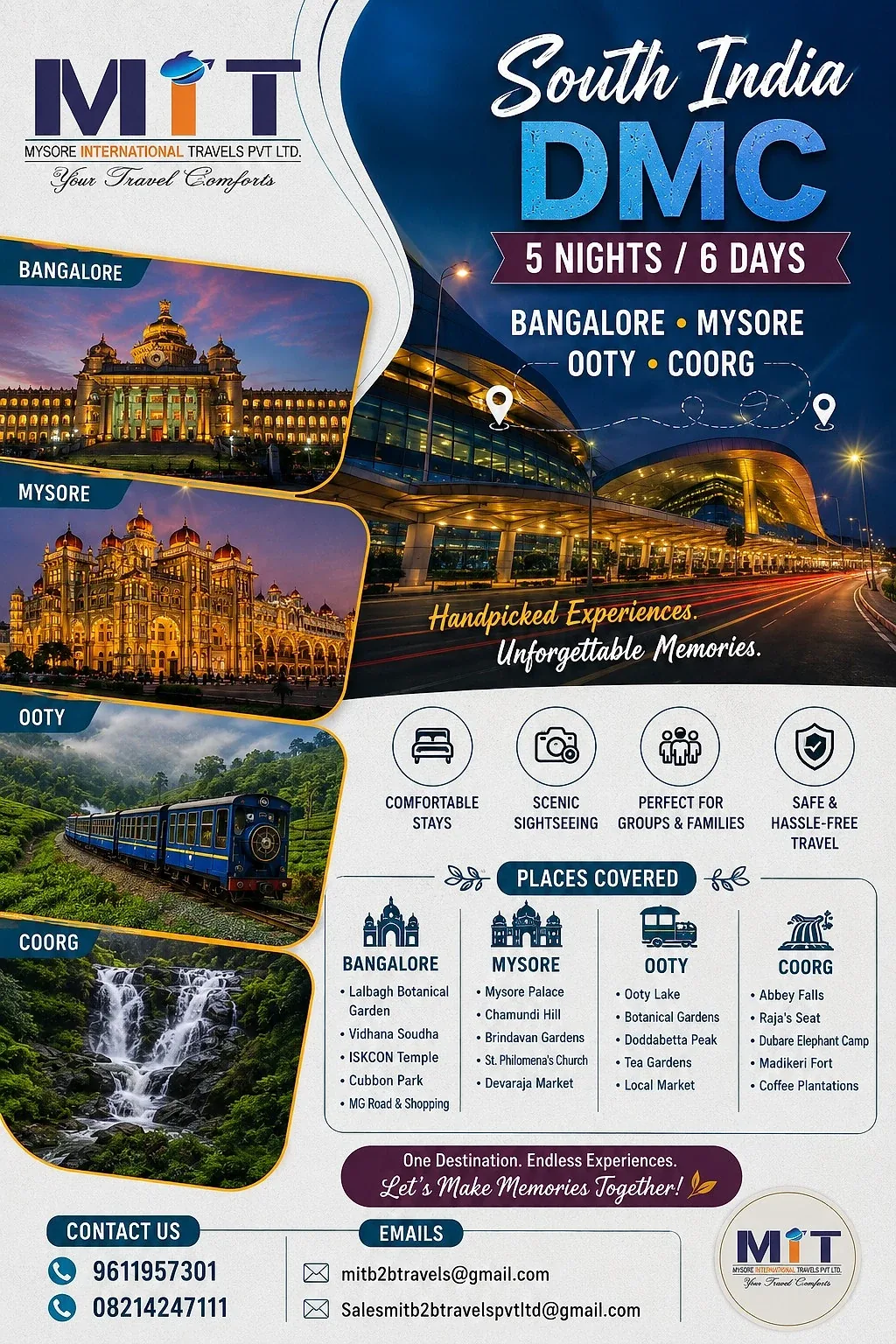 5N / 6D
 Bangalore → Mysore → Ooty → Coorg
One Destination. Endless Experiences.
Tell us your dates and group size — we'll build a Coorg plan around you.