What pilgrimage tours does Mysore International Travels (MIT) organise?
MIT plans temple and spiritual circuit tours across India, including the Karnataka Shakti Peetha and goddess temple circuit, Tirupati, Shirdi, the Chota Char Dham route (Yamunotri, Gangotri, Kedarnath, Badrinath), and Varanasi. Itineraries are customised to your dates, group size, and which shrines you want to cover, so get in touch to shape a trip around your specific pilgrimage plans.
Which Shakti Peethas and goddess temples in Karnataka does MIT cover?
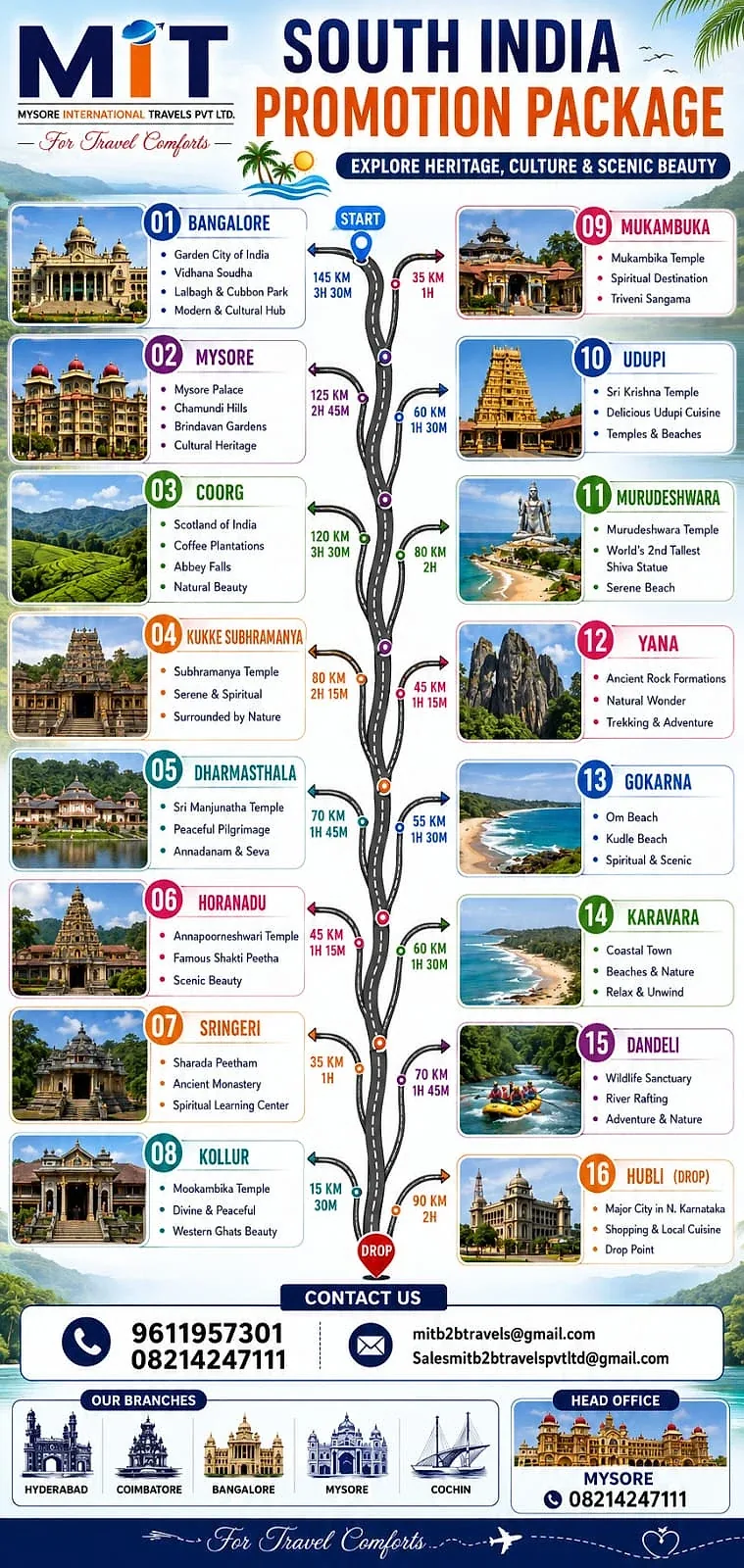
Karnataka is home to several important Devi temples that pilgrims regularly visit as a circuit, most notably the Chamundeshwari Temple atop Chamundi Hills in Mysore and the Mookambika Temple at Kollur. MIT, being based in Mysore, is well placed to plan a comfortable multi-day route covering these and other significant shrines in the state — reach out with your preferred temples and MIT will build the itinerary around them.
Does MIT organise Char Dham Yatra packages?
Yes. MIT arranges the Chota Char Dham circuit in Uttarakhand — Yamunotri, Gangotri, Kedarnath, and Badrinath — as a customised multi-day itinerary covering transport, accommodation, and local coordination. Contact MIT with your preferred travel dates and group size for a tailored plan and quote.
What is included in a Char Dham Yatra package from MIT?
A typical Char Dham itinerary from MIT covers road and/or rail transport as required, hotel or guesthouse accommodation en route and near each shrine, local vehicle arrangements for the hill sections, and coordination support throughout the journey. Exact inclusions vary based on the duration, mode of travel, and comfort level you choose, so MIT confirms these clearly in your customised quote before booking.
How much does a Char Dham Yatra cost?
Char Dham Yatra costs vary widely depending on group size, duration, choice of accommodation, whether you travel by road or use helicopter services for parts of the route, and the season you travel in. Rather than quote a generic figure, MIT prepares a detailed, transparent cost estimate once it understands your dates, group size, and preferences — contact MIT for a customised quote.
How many days are needed for the Char Dham Yatra?
The full Chota Char Dham circuit covering Yamunotri, Gangotri, Kedarnath, and Badrinath typically takes a fairly extended trip given the travel distances and altitude involved, and pacing matters for comfort and safety. MIT designs the day-wise schedule based on your available time and whether you want to cover all four shrines or focus on select ones like Kedarnath.
What is the difference between Chota Char Dham and the original Char Dham?
The term "Char Dham" traditionally refers to four cardinal pilgrimage sites across India — Badrinath, Dwarka, Puri, and Rameswaram — associated with Adi Shankaracharya. "Chota Char Dham" (or Chhota Char Dham) refers to the more commonly booked Himalayan circuit within Uttarakhand: Yamunotri, Gangotri, Kedarnath, and Badrinath. When people ask about "Char Dham" tours alongside Kedarnath, they usually mean this Himalayan circuit, and that is what MIT typically arranges.
What is the best time to do the Char Dham Yatra and visit Kedarnath?
The Char Dham shrines, including Kedarnath, are generally accessible only during a limited window each year, typically from around late April/May through October or early November, as the temples close for winter due to heavy snow. Late May to June and September to October tend to be popular periods, avoiding the peak monsoon months when landslides can disrupt hill roads. MIT can advise on current-year opening and closing dates when you enquire.
Is a Kedarnath trip suitable for senior citizens or people with mobility issues?
Kedarnath involves a trek from Gaurikund (or a shorter distance if using pony, palanquin, or helicopter services from designated points), along with high-altitude conditions, so it does require some physical preparedness. MIT plans the trip with realistic pacing and can help arrange pony, palanquin, or helicopter options where available, and advises families honestly on what to expect so they can decide what's comfortable for elderly or less mobile travellers.
Does MIT help with Kedarnath helicopter bookings?
Yes, MIT can assist with arranging helicopter tickets to Kedarnath through the authorised operators, subject to seat availability, weather conditions, and the operating schedule for that season. Since helicopter seats are limited and in high demand, it helps to enquire well in advance of your travel dates.
Do I need to register in advance for the Char Dham Yatra?
Yes, the Uttarakhand government requires pilgrims to complete an online yatra registration before undertaking the Char Dham Yatra, and this process can change from year to year in its specifics. MIT keeps track of the current registration requirements and can guide you through what's needed as part of planning your trip.
How far in advance should I book a Char Dham or Kedarnath pilgrimage?
Given limited accommodation near the shrines, seasonal helicopter demand, and yatra registration requirements, it's advisable to start planning a Char Dham or Kedarnath trip a few months ahead of your intended travel window, especially if you're travelling during the peak May–June period. Booking early gives MIT more flexibility to secure convenient stays and transport options for your group.
Does MIT arrange Tirupati darshan tickets?
MIT can assist with planning your Tirupati visit, including accommodation and local transport, and guiding you on the darshan options available at the Tirumala Tirupati Devasthanams (TTD), such as the general queue and various special entry facilities offered by TTD. Since darshan slots are managed directly by TTD and demand fluctuates seasonally, it's best to plan your visit and enquire with MIT well ahead of your travel dates.
How much does a Tirupati Balaji darshan package cost?
Costs for a Tirupati trip depend on your travel mode (road, rail, or flight to nearby airports), choice of accommodation near Tirumala or Tirupati town, group size, and duration of stay. MIT puts together a clear, itemised quote once it understands your preferences rather than working off a fixed generic price — reach out for a customised estimate.
Can I combine Tirupati and Shirdi in a single pilgrimage trip?
Yes, some pilgrims like to combine well-known shrines like Tirupati and Shirdi into one extended trip, and MIT can plan the logistics for this, working out sensible travel connections and pacing between the two. Since the two are a considerable distance apart, MIT will map out realistic travel days so the trip doesn't feel rushed.
How much does a Shirdi Sai Baba pilgrimage package cost?
A Shirdi trip's cost depends on your travel mode, duration, choice of accommodation near the temple, and whether it's combined with other destinations. MIT provides a transparent quote tailored to your specific plan — contact the team with your dates and group size for current rates.
What is included in a Varanasi pilgrimage tour?
A Varanasi pilgrimage itinerary from MIT typically covers accommodation, local transport, and coordination for visiting key sites along the ghats, including the evening Ganga Aarti and temple visits such as the Kashi Vishwanath Temple. Boat rides on the Ganges and any extended sightseeing are arranged as part of your customised plan based on how much time you have.
What's the best time to visit Varanasi for a pilgrimage?
Varanasi can be visited year-round for pilgrimage purposes, but the cooler months from October to March tend to be more comfortable for walking along the ghats and attending the Ganga Aarti, avoiding the intense summer heat and monsoon flooding of the river. MIT can advise on the current conditions when planning your dates.
Can MIT plan a pilgrimage tour departing from Bangalore, Hyderabad, Coimbatore, or Cochin, not just Mysore?
Yes. While MIT's head office is in Mysore, it also has branches in Bangalore, Hyderabad, Coimbatore, and Cochin, and can arrange pilgrimage tours starting from any of these cities to suit where your group is travelling from.
Do you arrange transport, accommodation, and guides, or just book tickets?
MIT arranges the full picture — transport (road, rail, or flights as needed), accommodation near each shrine, local guide and driver coordination, and assistance with darshan-related arrangements — rather than just issuing tickets. The goal is to handle the logistics so you can focus on the pilgrimage itself.
What's the advantage of booking a pilgrimage tour through MIT instead of arranging each temple, hotel, and vehicle myself?
Pilgrimage routes like Char Dham or the Karnataka Shakti Peethas involve coordinating multiple stays, local transport changes, seasonal timing, and sometimes registration formalities — a lot to manage on your own, especially for families with elderly members. Booking through MIT means one point of contact handling these moving parts, backed by the proprietor's 22+ years of trade experience, so you get a realistic, well-paced itinerary instead of piecing one together and hoping it works out.
Can MIT organise pilgrimage tours for large groups, temple committees, or associations?
Yes, MIT works with both individual families and larger groups, including temple committees and associations planning a joint pilgrimage. Group logistics — vehicles, block accommodation, and pacing for a larger number of travellers — are worked out as part of the customised planning process, so share your expected group size when you enquire.
What should I pack for a Himalayan pilgrimage like Char Dham or Kedarnath?
Himalayan pilgrimage routes involve cold temperatures, altitude, and sometimes rain, so warm layered clothing, comfortable walking shoes, a rain jacket or poncho, and any personal medication are generally recommended, along with checking with your doctor if you have health conditions affected by altitude. MIT shares a more detailed pre-departure briefing specific to your itinerary and travel dates once your trip is confirmed.
How do I book a pilgrimage tour with MIT?
Reach out with your preferred shrines, travel dates, and group size via phone or WhatsApp at +91 96119 57301, the landline at 0821 424 7111, or email at mitb2btravels@gmail.com. MIT will put together a customised itinerary and quote, and once you're happy with it, confirm the booking and MIT takes care of the rest.
Is Tirupati open for darshan throughout the year, or are there specific pilgrimage seasons?
Tirupati's Sri Venkateswara Temple is open for darshan year-round, unlike some Himalayan shrines that close for winter. That said, certain periods — such as around the annual Brahmotsavam festival — see significantly heavier crowds, so if you'd prefer a quieter visit, it's worth discussing timing with MIT when planning your trip.
Can pilgrimage tours be combined with leisure sightseeing, like Karnataka's hill stations or Kerala backwaters?
Yes, many travellers like to combine a spiritual circuit with some leisure time, and MIT — being a full-service South India DMC covering destinations across Karnataka, Kerala, and beyond — can build an itinerary that blends temple visits with a few days of sightseeing or relaxation nearby. Just mention this when sharing your requirements so it can be woven into the plan.